
Dutch road markings explained: shark teeth, block markings and hatched areas
The CBR theory exam does not only ask about signs, but also about the lines and symbols on the road. Do you know the difference between a block marking and a broken line, what shark teeth mean, or whether you may drive over a hatched area? This article covers every road marking you need to know.
Shark teeth
Shark teeth (haaientanden) are white triangles on the road, pointing towards you. They mean: give way to drivers on the crossing road. They have the same meaning as sign B6 and are often placed together with it.
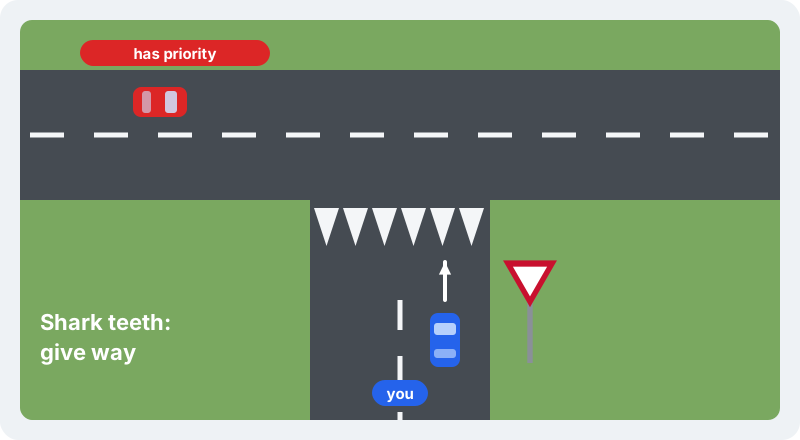
- You find them at priority intersections, roundabouts and where a cycle path crosses a road.
- They apply to drivers on the road where they are painted. They do not give pedestrians priority; that requires a zebra crossing.
- A tram must also give way at shark teeth.
Read more about who goes first in our guide priority rules explained.
Solid, broken and warning lines
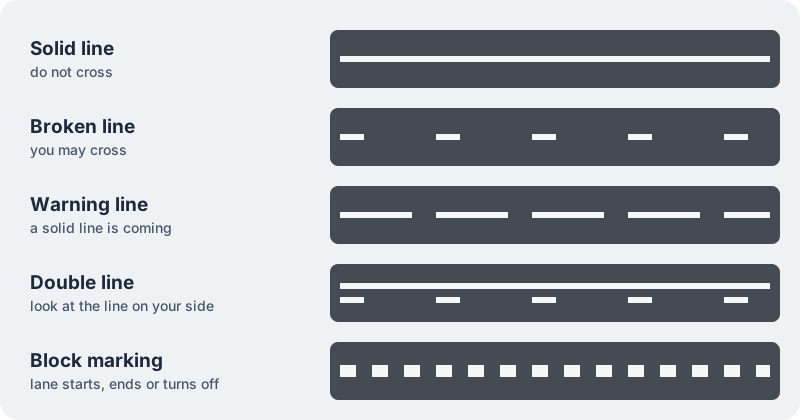
| Marking | Meaning |
|---|---|
| Solid line | Do not cross it and do not drive on it. |
| Broken line | You may cross it, for example to overtake, if it is safe. |
| Warning line (long dashes, short gaps) | You are approaching a solid line or a dangerous point. You may still cross it, but finish your overtaking manoeuvre. |
| Double line (solid + broken) | Look at the line on your side: on the broken side you may cross, on the solid side you may not. |
| Block marking | Separates a lane that starts or ends from the through carriageway. You may cross it. |
Block marking
A block marking (blokmarkering) is a wide broken line made of short, thick blocks. You mainly see it on motorways and main roads (autowegen):
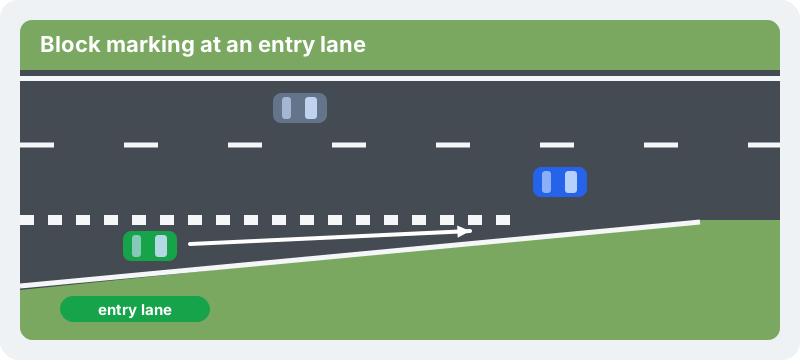
- between the through carriageway and an entry lane or exit lane;
- along a rush-hour lane (spitsstrook or plusstrook);
- next to a lane that ends or turns off further ahead.
So the block marking says: watch out, this lane is going to do something different from the lane next to it. You may cross it, for example to merge or to take the exit. On a motorway a block marking also shows that the lane to its right will soon disappear or lead to an exit.
Hatched area and gore
A hatched area (verdrijvingsvlak) is a white area with diagonal stripes, usually with a white border. It "pushes" traffic to the right side. On a hatched area you may not drive, stop or park. Not even briefly to overtake or to reach the exit faster.
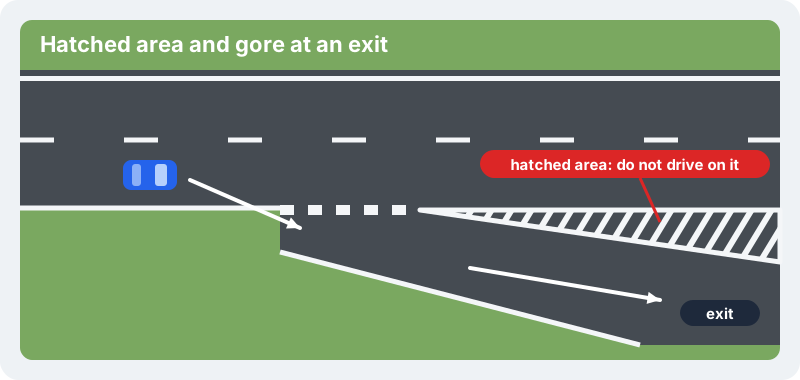
The gore (puntstuk) is the pointed area between two carriageways that split or merge, for example at an exit. It is usually a hatched area or a raised section. You do not drive over it either: if you miss your exit, carry on to the next one.
Yellow lines: stopping and parking
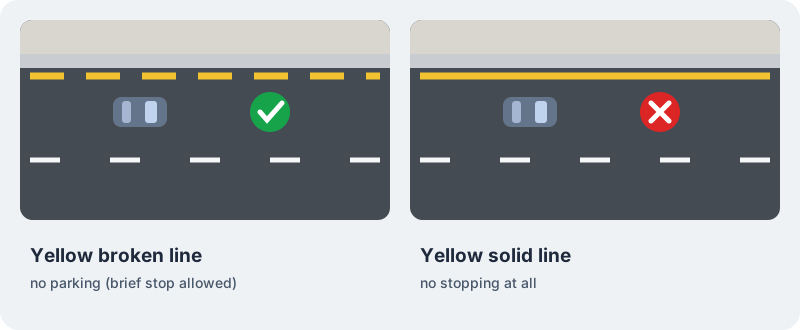
- Yellow broken line on or along the edge of the road: no parking. Stopping briefly to let someone in or out is allowed.
- Yellow solid line: no stopping. You may not even stop briefly.
- Block marking at a bus stop: you may not stop there, except to let passengers get on or off straight away (article 23 RVV 1990).
Cycle lane and advisory cycle lane
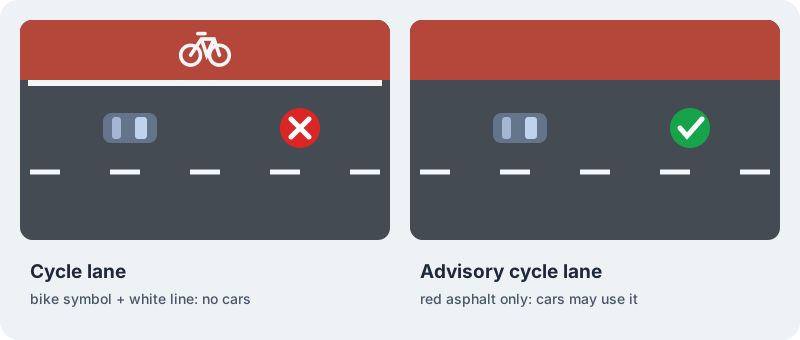
A cycle lane (fietsstrook) is a lane for cyclists and moped riders, with a bicycle symbol and a white line. As a car driver you may not drive or park in it. If the line is broken, you may cross the lane, for example to turn or to let an oncoming car pass.
An advisory cycle lane (fietssuggestiestrook) looks similar (often red asphalt), but has no bicycle symbol and no official line. It is not a real cycle lane: cars may drive on it, but must take cyclists into account.
Other markings on the road
- Zebra crossing: wide white stripes; pedestrians who are crossing or want to cross go first.
- Stop line: a wide solid line across the road; here you stop at a stop sign (B7) or a red light.
- Arrows on the road: show which direction you may take from that lane. Choose the right lane in good time.
- Blue lines: in many municipalities they mark parking bays in a blue zone, where you must use a parking disc.
- Bus lane: recognisable by "BUS" on the road; only for public service buses (and sometimes taxis, if indicated).
Frequently asked questions
May you use a hatched area to turn around or merge?
No. You may not drive on it, not even briefly.
Does a block marking count as a solid line?
No. A block marking is broken and you may cross it. It only warns that the lane next to it starts, ends or turns off.
What is the difference between shark teeth and a stop line?
At shark teeth you give way, but you do not have to stop if the road is clear. At a stop sign with a stop line you must always stop completely.
Practise every sign and its meaning in the traffic signs database or test yourself with the traffic signs quiz.
Stay updated on CBR exams & theory tips
Add Zielaan to your preferred sources in Google Search to always see our newest exam tips and CBR changes.
Ready to practise?
Test your knowledge of lines, signs and priority in a free CBR practice exam.
Start free practice exam